You can hold a current EEHA Statement of Attainment, follow every Ex rule to the letter, open the enclosure exactly as you were trained to — and still be standing in front of the thing that burns you.
The short version: EEHA stops your gear from igniting the atmosphere around it. Arc flash is about what that gear does to you when it faults. Two different hazards, two different sets of controls, two different tickets.
Arc flash vs EEHA: the difference in plain English
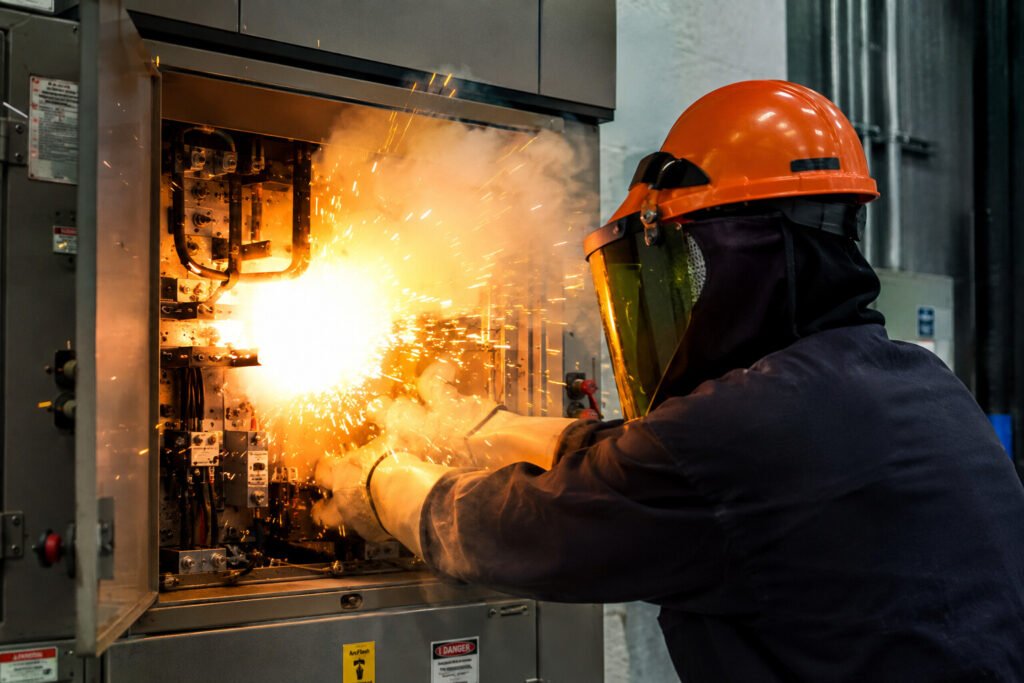
Arc flash — what the fault does to you. Current jumps through air between phases or to earth. You get radiant heat, a pressure wave, molten copper spray and a flash bright enough to take your sight, all inside a few dozen milliseconds. No warning and no time to move. Arc flash controls exist to protect the person standing at the door.
EEHA — what your gear does to the atmosphere. In a classified area, the fuel and the air are already there. EEHA makes sure your equipment never supplies the third ingredient: no spark, no arc, no surface hot enough to light gas, vapour, mist or dust. EEHA controls exist to protect the whole plant.
What your EEHA ticket actually covers
EEHA is a skill set of nationally recognised units from the UEE Electrotechnology Training Package, usually delivered over five days and aligned to the AS/NZS 60079 series. It is the ticket that gets a licensed electrician into a classified area and keeps them there.
It teaches you to:
- Enter and work in a classified hazardous area
- Read the classification, the zone and the equipment markings
- Determine the explosion-protection technique required for the job
- Install explosion-protected equipment so the protection still works afterwards
- Inspect and maintain Ex installations, and record it properly
Every one of those is about ignition. That is the entire point of the qualification. Which means there is a list of things your EEHA ticket never claimed to teach you:
- How much incident energy is available at the board you are about to open
- Where the arc flash boundary sits, and who is allowed inside it
- Which arc-rated PPE matches that energy, and which PPE is decorative at that level
- How upstream protection settings and clearing time change the answer
- What to do differently when the label says the energy is high
Worth saying plainly: this is not a gap in your training. EEHA is doing its job. Arc flash is simply a different hazard sitting on the same equipment, and it needs its own bit of learning.
What an arc flash does at the board
Arc temperatures run in the order of 19,000°C at the terminals, several times hotter than the surface of the sun. But the heat is only half of it. Copper turning to vapour expands to roughly 67,000 times its solid volume, and that is what throws cubicle doors across a switchroom, ruptures eardrums and drives molten metal into whatever is in front of it.
The people who survive one are usually not back at work for months, and often not back in the trade.
What sets them off
- Racking a breaker in or out under load, or with a mechanism that has not been serviced
- Testing and fault-finding live, where your probes and your clearances are the only thing between you and the busbar
- A dropped tool or torch across terminals — the classic, and still one of the most common
- Vermin, snakes and birds bridging live parts in outdoor and remote gear
- Loose or overheated terminations that have been quietly cooking for a year
The thing most people miss: how badly you get hurt depends as much on how long the arc lasts as on how big it is. A protection device that takes an extra 200 milliseconds to clear can be the difference between a bad day and a fatality. That is why the label on the door matters — it already accounts for it, and you cannot eyeball it.
Arc flash vs EEHA: side-by-side comparison
| Arc Flash | EEHA | |
|---|---|---|
| The hazard | Energy released by a fault in the equipment | Ignition of the flammable atmosphere around the equipment |
| Who gets hurt | The person standing in front of it | Everyone on the plant |
| Where it applies | Every board, MCC, substation and drive on site | Only inside classified zones — 0, 1, 2 and 20, 21, 22 |
| Your job on the day | Isolate and prove dead; if not, PPE to the label and respect the boundary | Correct Ex technique, glands, fasteners and seals, and record the inspection |
| The training | Arc Flash Safety & Awareness — short, online, self-paced | EEHA skill set — five days, theory plus practical assessment |
| What you get | Certificate of Attendance (non-accredited awareness training) | Statement of Attainment listing nationally recognised units |
| Who can enrol | Anyone working in or around electrical equipment, trade or not | Licensed electricians — unrestricted licence or Cert III required |
| Staying current | Employer and site driven; refresh when procedures or roles change | Refresher every 2–3 years is standard industry practice |
| Standards behind it | IEEE 1584, AS/NZS 4836, AS 2067, site electrical safety rules | AS/NZS 60079 series, AS/NZS 3000 |
| Who asks for it | Employers, principal contractors, SWMS and switching authorities | Site access for mining, oil and gas, chemical and bulk handling |
Standards shown are indicative of current Australian practice. Site rules and state requirements vary — always work to the ones that apply where you are.
Where arc flash and EEHA overlap
On a mine site or a gas plant, these two hazards are not in different buildings. They are in the same cubicle, on the same job card, at the same moment you undo the last fastener.
- EEHA only: field instruments, lighting and junction boxes, where the fault energy is next to nothing.
- Both at once: Ex switchgear, MCCs, VSDs and motor circuits. Certified against ignition, and still able to put out a serious arc.
- Arc flash only: substations, HV and LV boards and distribution gear across the rest of the site.
The gap in one line: a flameproof enclosure is built to contain an explosion inside itself. An intrinsically safe circuit limits energy below what will light gas. Neither of them limits the fault current available from the transformer upstream — and neither of them is doing anything at all once you have the door open.
That is the exact moment the two disciplines cross over. You have done everything EEHA asked of you to get that enclosure open safely. And now you are inside the arc flash boundary, with the protection settings and the incident energy deciding how the next 200 milliseconds go.
How it plays out on a coal handling plant
Coal handling is where the two overlap hardest: combustible dust classification sitting right on top of heavy electrical infrastructure. Say you are the sparky on nights.
What both disciplines have already done. Transfer points and the crusher house are classified for combustible dust, so every motor, light, isolator and instrument inside the boundary is Ex-certified. Separately, someone has calculated the incident energy at the 11 kV incomer, the 415 V boards and the conveyor MCC, and put a label on each door with a boundary and a PPE requirement.
The callout. Late on a night shift, the conveyor drive keeps tripping on overload. Production wants it back. You are walking to the MCC, which sits right at the edge of the classified area.
Your EEHA obligations. Clearance for the area, correct Ex re-assembly, gland integrity, no substituted fasteners, seals intact, and an inspection record so the dossier still means something.
Your arc flash obligations, on the same job. Isolate and prove dead if you possibly can. If you genuinely cannot, then it is PPE matched to the label, the boundary respected, a second person, and any maintenance-mode protection setting applied before the door opens, not after.
Two ways it goes wrong. Get the EEHA side wrong and a spark finds a dust cloud — the plant is the casualty. Get the arc flash side wrong and you are. Doing one perfectly does nothing whatsoever for the other.
Does this apply to you?
Have you done any of these on site in the last twelve months?
- Opened a switchboard, MCC or distribution board door
- Racked a circuit breaker in or out
- Taken live readings while fault-finding
- Operated an isolator or switched a board under load
- Worked on or near a VSD, soft starter or motor circuit
- Stood next to someone else doing any of the above
If you ticked even one, arc flash is part of your working day — whether or not there is a hazardous area anywhere near you.
Which tickets do you actually need?
Nobody needs every course on the list. What you need depends on where you work and what you are allowed to touch.
Sparky on a plant with no classified areas. Manufacturing, water, food processing, commercial. You want Arc Flash Awareness, LV Switching, Isolation and Lockout, and LVR & CPR.
Heading to the mines or a gas plant. Chasing FIFO or hazardous area work. You want the EEHA Full Course, Arc Flash Awareness and LVR & CPR. Not sure when to book it? Read when to get EEHA training.
Already working in hazardous areas. EEHA done a couple of years back and getting stale. You want the EEHA Refresher and Arc Flash Awareness. Not sure if yours has lapsed? See does your EEHA expire.
Moving up to supervision. Leading hands, inspection coordination, compliance and oversight roles. You want the Certificate IV in Hazardous Areas, HV Switching and Arc Flash Awareness. More on that choice in EEHA vs Certificate IV in Hazardous Areas.
New to hazardous area work altogether? Start with hazardous area zone classifications explained, or if the mines are the goal, what qualifications you need to work in the mines as an electrician.
Where ROAR Training fits in
We deliver both sides of this article from our Sunshine Coast facility and online.
Arc Flash Safety & Awareness Course — $160. Non-accredited, self-paced online. Recognise the hazard, understand boundaries, read the labels, and get LOTO and arc-rated PPE straight. Certificate of Attendance on completion. No electrical licence required — open to electricians, supervisors, operators and HSE staff alike.
EEHA Training, Full Course — $2,400. The hazardous area ticket. Nationally recognised UEE units aligned to AS/NZS 60079, theory plus hands-on practical. Requires an unrestricted electrical licence or Certificate III.
EEHA Refresher Course — $1,200. Keeps you current when your EEHA is two to three years old. Leave it past five and most RTOs will send you back through the full course.
UEE42622 Certificate IV in Hazardous Areas — $1,800. The EEHA units plus four core units, for supervision, inspection and compliance roles. Already hold your EEHA with us? It is gap training, not a restart.
Frequently asked questions
Is arc flash covered in EEHA training?
No. EEHA covers explosion protection — keeping your equipment from igniting a flammable atmosphere. It does not cover incident energy, arc flash boundaries or arc-rated PPE selection. They are separate hazards and separate training.
Do I need arc flash training if all my gear is Ex-certified?
Yes. Ex certification is about ignition, not fault energy. Your Ex switchgear is fed from the same network as everything else on site, so the fault current and the clearing time — the two things that decide how badly an arc hurts you — are exactly the same as they would be anywhere else.
Do I need an electrical licence to do the arc flash course?
No. The Arc Flash Safety and Awareness course is open to anyone who works in or around electrical equipment: electricians, supervisors, maintenance crews, operators, HSE staff and contractors. EEHA is different — that one requires an unrestricted Australian electrical licence or a Certificate III in Electrotechnology Electrician.
Is the arc flash course accredited, and how long does it take?
It is non-accredited awareness training and you receive a Certificate of Attendance, which is what most employers and site inductions ask for. EEHA and the Certificate IV are the nationally recognised credentials. Delivery is self-paced online with immediate access, so it takes as long as you need. Trainers are available Monday to Friday, 8:00am to 4:00pm.
Which standards apply to each one?
EEHA sits under the AS/NZS 60079 series, aligned to IEC 60079. Arc flash work in Australia draws on IEEE 1584 for calculating incident energy, plus AS/NZS 4836 for safe working on low-voltage installations and AS 2067 above 1 kV. Over the top of both sits the WHS duty to manage electrical risk so far as is reasonably practicable.
Can I just wear the PPE and skip the rest?
PPE is the last line of defence, not the first. It reduces how badly you burn; it does not stop the blast, the noise or the event itself. Verified isolation, proving dead, respecting the boundary and getting the protection settings right do far more of the work. The PPE covers what is left over.
Do you deliver in PNG?
We train electricians and mining crews across Australia and PNG. The arc flash course is self-paced online so location is not an issue. For EEHA and the Certificate IV, get in touch about delivery options for your site or crew.
The bottom line
Arc flash and EEHA are not competing with each other, and you are not choosing between them. EEHA keeps your equipment from lighting up the atmosphere. Arc flash awareness keeps you from wearing the consequences when that same equipment faults.
Next time you are in front of a board, ask both questions of it: could this ignite what is around it, and what happens to me if it lets go right now? If your training only answers the first one, that is the gap — and it is a cheap one to close.
Ready to close it? The Arc Flash Safety and Awareness Course is $160, self-paced, and starts the moment you enrol. Or talk to a course advisor if you are not sure what your site requires.
General information only. Always work to the electrical safety rules and procedures that apply on your site. ROAR Training, RTO 6302, Sunshine Coast, Queensland.