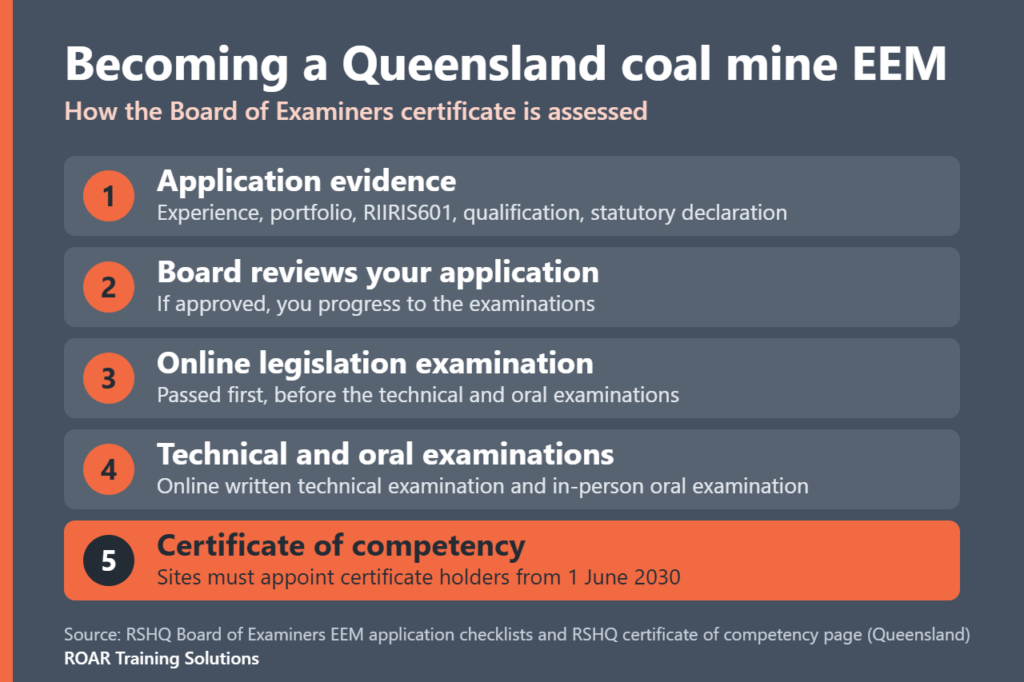
From 1 June 2030, Queensland coal mines must appoint Electrical Engineering Managers (EEMs) who hold the relevant certificate of competency, according to Resources Safety and Health Queensland (RSHQ). A training provider doesn’t issue that certificate. The Board of Examiners does, after reviewing your evidence and assessing you in examinations.
This article covers Queensland coal mining. New South Wales and other jurisdictions have their own requirements.
What the dates mean
RSHQ is introducing new certificates of competency over five years. Two dates matter for an EEM or someone planning to become one:
- From 1 June 2026: all applicants complete the full assessment process, which includes the online law, online written technical and oral examinations.
- From 1 June 2030: it is mandatory for sites to appoint personnel who hold the relevant certificate of competency to these roles.
For these roles RSHQ lists the certificate together with a practising certificate.
RSHQ encourages people in these roles, or considering them, to learn the requirements now. It also asks Site Senior Executives to build them into training needs analysis and succession plans.
What the Board asks for
The Board publishes separate application checklists for surface and underground EEMs. The structure is similar, but the experience requirements differ.
| Requirement | Surface EEM | Underground EEM |
|---|---|---|
| Coal mining experience | At least five years in coal mining other than underground | At least five years in underground coal mining |
| Hands-on electrical work | Two years installing, commissioning, maintaining and repairing electrical plant and installations | The same two years |
| Specific plant experience | A year working with electrical plant, including at least six months on electrically powered heavy earth-moving machines or coal handling and preparation plants | A year with electrical plant, including at least six months at an extraction face during production or development |
| Supervision | Two years supervising electrical plant and installations, including worker development and delivery such as toolbox talks and shift briefings | Two years supervising electrical plant and installations at an underground coal mine, including the same development and delivery work |
| Verification | Work history verified by the appointed EEM, and endorsement from your EEM if you work at a coal mine | The same |
Both checklists also require:
- A curriculum vitae and work history evidence.
- A portfolio of site activities, with an explanation of how each criterion was met. It covers:
- a risk assessment
- a workplace inspection
- a review of a Fatal Hazard Management Plan or Engineering Management Plan
- an electrical work plan or compliance report
- a workplace training plan
- a standard operating procedure or work instruction
- an electrical investigation
- For surface EEMs, a portfolio spreadsheet giving an overview of each topic.
- A Certificate of Attainment for RIIRIS601 Establish and Maintain Risk Management Systems.
- An acceptable electrical engineering qualification (see below).
- A Queensland statutory declaration, with qualifications verified by a Justice of the Peace or a Commissioner for Declarations.
If the Board approves your application to progress, you sit the online legislation examination first. You must pass it before you can sit the online technical examination and the in-person oral examination.
Where the Advanced Diploma fits
The checklists ask for an acceptable electrical engineering qualification and give examples. The list isn’t presented as exhaustive:
- Bachelor of Engineering (Electrical Engineering) from an Australian university
- Advanced Diploma of Electrical Engineering (Coal Mining), UEE62320 or a superseded version
- Advanced Diploma of Electrical Engineering, UEE62220 or a superseded version
- Advanced Diploma of Applied Electrical Engineering (Renewable Energy), 52894WA
- Advanced Diploma of Applied Electrical Engineering (Electrical Systems), 52883WA
So an Advanced Diploma is one acceptable way to meet the qualification criterion. It isn’t the requirement itself, and it doesn’t replace the experience, portfolio, RIIRIS601 or examinations.
ROAR Training Solutions (RTO 6302) delivers UEE62325 Advanced Diploma of Electrical Engineering – Coal Mining. The national register shows UEE62320 as superseded on 29 July 2025 and UEE62325 as current from 30 July 2025.
Because the checklists name UEE62320 “or superseded version”, ask the Board to confirm how it treats the current release before you enrol.
What a course doesn’t do
Completing a qualification doesn’t give you a certificate of competency, a practising certificate or an appointment. The Board decides on the certificate, and the mine manager appoints the EEM.
Check your evidence before you choose training
- Download the surface or underground checklist from the RSHQ certificates of competency page.
- Match your work history against the experience criteria and note any gaps.
- List the qualifications you hold, including RIIRIS601, and check them against the examples above.
- If you need a qualification, compare the entry requirements on the UEE62325 course page with your current evidence.
- Contact the Board of Examiners to confirm whether your qualification is acceptable.