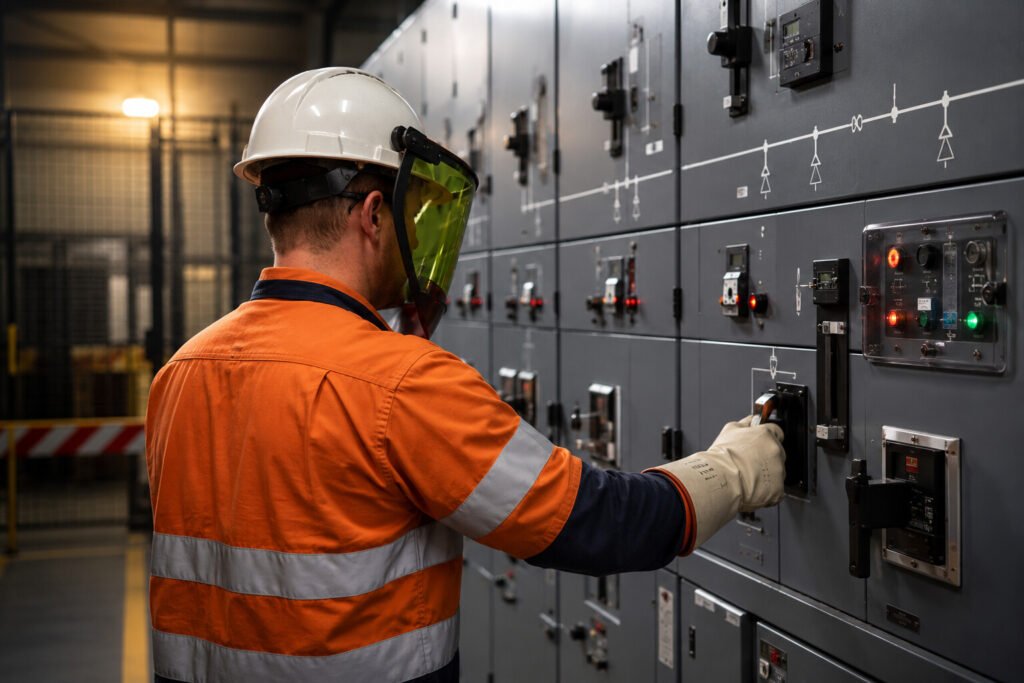
Passing an HV Switching Operations course does not hand you a switch and walk away. What it actually gives you is the competency to plan and carry out switching to a set program, under a permit, on equipment your employer or the network owner has specifically authorised you to touch. The course is the first gate. Site authorisation is the second. This is what sits on the other side of both.
What the ticket actually authorises you to do
Once you are qualified and authorised, HV switching work generally covers:
- Isolating HV equipment so it is safe for others to work on
- Earthing equipment as part of an isolation sequence
- Energising and de-energising HV plant in a controlled order
- Developing and following a switching program or switching sheet
- Issuing and receiving access permits
- Verifying that an isolation point is actually isolated, not just switched
- Working safely in the vicinity of live HV apparatus while all of the above happens around you
None of this is something you improvise on the day. The order matters, the paperwork matters, and a switching program exists precisely so that nobody has to rely on memory when the consequences of getting a step wrong are this serious.
Training, competency and authorisation are three separate things. Finishing the course proves you understand switching theory and procedure. Authorisation is a decision your employer or the network owner makes separately, usually after they have watched you demonstrate the competency on their equipment, under their rules. Nobody switches HV apparatus on the strength of a certificate alone — site sign-off is what actually puts you on the roster.
HV switching vs LV switching, in one table
These two get confused constantly, mostly because the word “switching” is doing double duty. They are not the same authorisation, and one does not substitute for the other.
| LV Switching | HV Switching | |
|---|---|---|
| Voltage range | Below 1,000V AC | Above 1,000V AC |
| Typical equipment | Distribution boards, LV switchboards, field devices | Substations, RMUs, HV switchgear, HV transformers |
| Formality of process | Site procedure and isolation practice | Formal switching program, permits, access authority |
| Relationship | Prerequisite unit for HV switching | Builds on LV switching competency |
If you have not completed LV field switching yet, that is the starting point, not a separate detour — it is a prerequisite unit for the HV course, not an alternative to it.
The equipment you are actually working on
HV switching authorisation in Australia typically covers work on:
- HV substations and zone substations
- Ring Main Units (RMUs)
- HV circuit breakers, isolators and disconnectors
- HV transformers
- Mine site HV reticulation and distribution networks
- Overhead HV lines, where the site scope includes them
- HV motors and associated motor control equipment
Exactly which of these you are authorised on depends entirely on what your employer signs off — the course gives you the underpinning knowledge across all of it, but your day-to-day scope is whatever your site says it is.
Where HV switching tickets get used
HV switching sits behind a genuinely wide slice of Australian industry, because anywhere power moves at scale, someone has to be authorised to isolate it safely.
Mining. Mine sites run their own HV distribution networks end to end — substations, draglines, shovels, processing plants, conveyors and underground reticulation all draw through HV infrastructure that needs authorised operators on site, not flown in.
Utilities and network operators. Distribution and transmission networks depend on HV switching for planned outages, fault response, maintenance and new connections. This is the most visible use of the ticket, and the one most people picture first.
Oil and gas. LNG facilities, refineries, gas processing plants and offshore platforms run HV systems that need switching for maintenance and shutdown work, often on tight windows where an authorised operator being unavailable has a real production cost.
Heavy industrial and manufacturing. Smelters, refineries, mills and large chemical plants frequently run their own internal HV networks rather than buying power at LV, which means they carry their own HV switching operators as permanent site staff.
Renewable energy. Solar farms, wind farms, battery energy storage systems and their transmission connections are a fast-growing source of HV switching demand, and one of the newer places the ticket is opening doors.
What it does for your career
HV switching authorisation tends to open roles like HV switching operator, electrical supervisor, control room operator, HV maintenance technician and commissioning technician. Because the work carries genuine consequence — a switching error on HV apparatus is not a minor mistake — sites and employers generally attach a real pay premium to it compared to standard LV electrical work, though the exact figure varies by employer, site and region rather than being fixed.
It also stacks well with other tickets rather than standing alone. Electricians who pair HV switching with EEHA tend to be strong candidates for mining and processing roles specifically, since those sites usually need both hazardous-area competency and HV authorisation in the same person. It is also worth knowing that HV switching puts you in front of live apparatus that can arc fault if something goes wrong — a separate hazard from the switching procedure itself, and one arc flash training is built to cover.
Where ROAR fits in
The HV Switching Operations course is $2,200, nationally recognised, and delivered fully online and self-paced with up to 12 months to complete it. It requires a current Unrestricted Electricians Licence and the LV field switching unit as a prerequisite — if you have not done that unit yet, it can be completed online with ROAR for $300 and rolled straight into the HV course.
For the full breakdown of entry requirements, what the twelve units of competency actually cover, and how the online delivery works, see High Voltage Training: What HV Switching Is and Who Actually Needs the Ticket.
Frequently asked questions
Does finishing the HV switching course mean I can switch HV equipment?
Not on its own. The course gives you the competency, but your employer or the network owner still has to authorise you on their specific equipment before you switch anything. Training, demonstrated competency and site authorisation are three separate steps.
What is the difference between HV switching and LV switching?
LV switching covers equipment below 1,000V AC and is generally governed by site procedure. HV switching covers equipment above 1,000V AC and involves a much more formal process — switching programs, permits and access authority. LV field switching is a prerequisite unit for the HV course, not a separate alternative to it.
What equipment does an HV switching ticket cover?
Typically HV substations, ring main units, HV circuit breakers and isolators, HV transformers, mine site reticulation, and HV motors and motor control equipment. Your actual day-to-day scope depends on what your employer specifically authorises you on.
Which industries actually need HV switching operators?
Mining, utilities and network operators, oil and gas, heavy industrial and manufacturing sites that run their own HV networks, and increasingly renewable energy — solar farms, wind farms and battery storage systems all rely on authorised HV switching.
Do I need EEHA as well as HV switching?
Not automatically, but the two are commonly held together. Mining and processing sites in particular often need both hazardous-area competency and HV switching authorisation in the same person, so electricians targeting those sectors frequently hold both.
Can I do HV switching training fully online?
Yes. ROAR’s HV Switching Operations course is delivered fully online and self-paced, with up to 12 months to complete it. Face-to-face delivery is available for group bookings if a company wants a crew trained together.
The bottom line
An HV switching ticket is not a piece of paper that unlocks a switchboard by itself — it is the underpinning competency your employer builds site authorisation on top of. What it actually gets you is the ability to isolate, earth, energise and de-energise HV equipment under a formal, permit-based process, on whatever plant your site signs you off for. Across mining, utilities, oil and gas, heavy industrial and renewables, that authorisation is consistently one of the highest-value additions an electrician can make to their ticket stack.
Ready to start? The HV Switching Operations course is $2,200, fully online, self-paced, with up to 12 months to complete. Or talk to a course advisor if you are not sure whether you need the LV prerequisite first.
General information only. Authorisation to perform HV switching work is granted by your employer or the relevant network operator, not by course completion alone. ROAR Training, RTO 6302, Sunshine Coast, Queensland.